
• Skip to main content
  • Skip to secondary menu
  • Skip to primary sidebar
  • Skip to secondary sidebar
  • Skip to footer

  • COVID-19
  • Opinion
  • Health IT
    • Behavioral Health
    • Care Coordination
    • EMR/EHR
    • Interoperability
    • Patient Engagement
    • Population Health Management
    • Revenue Cycle Management
    • Social Determinants of Health
  • Digital Health
    • Artificial Intelligence
    • Blockchain
    • Mobile Health
    • Precision Medicine
    • Telehealth
    • Wearables
  • Startups
  • M&A
  • Value-based Care
    • Accountable Care (ACOs)
    • Medicare Advantage
  • Life Sciences
  • Research

RCM: Average Length of Clinical Notes Continues to Increase

by Syed Hamza Sohail 07/07/2023 Leave a Comment

  • LinkedIn
  • Twitter
  • Facebook
  • Email
  • Print

What You Should Know:

  • In 2021, the Centers for Medicare and Medicaid Services (CMS) implemented changes to evaluation and management (E/M) CPT billing codes aimed to reduce the administrative documentation burden on providers.
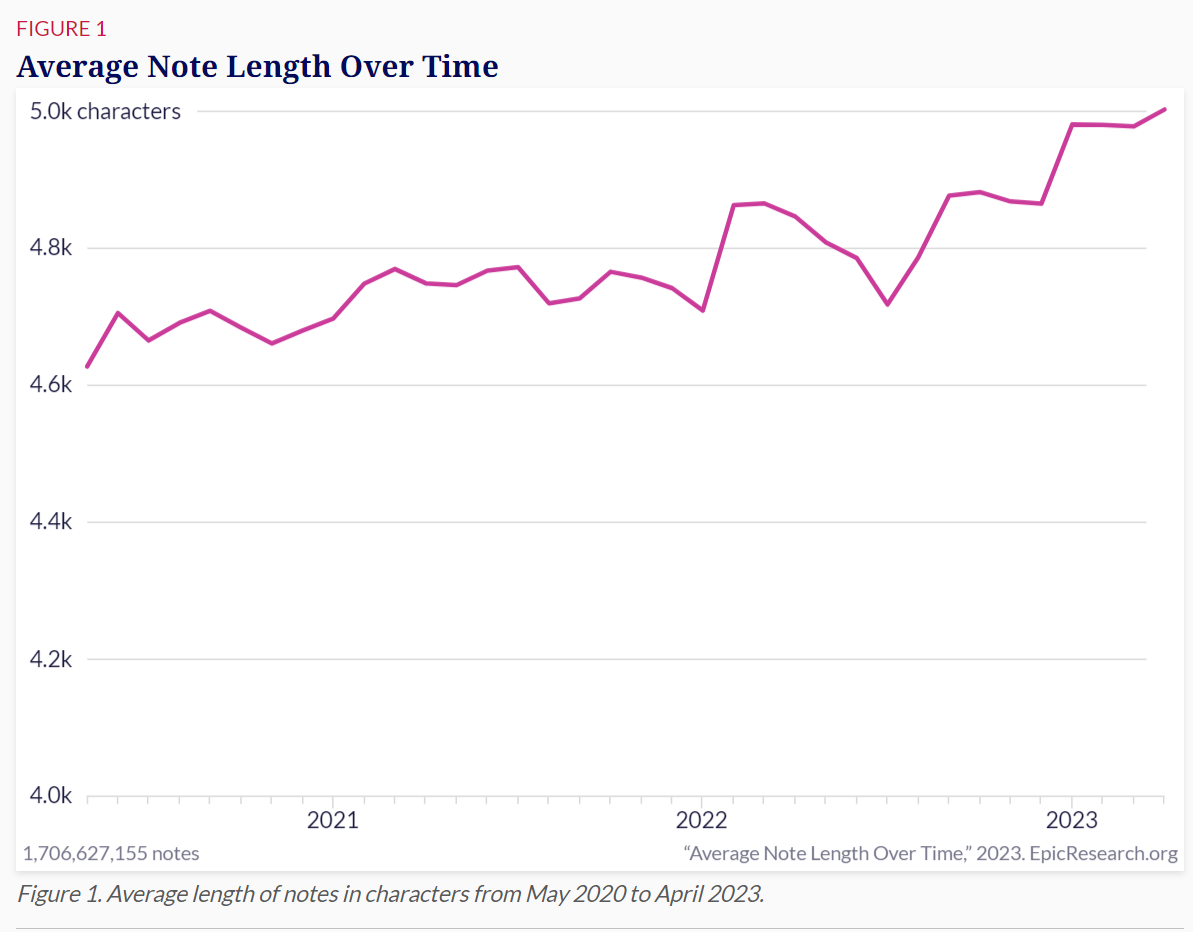
  • Epic Research just came out with a new study that shows the average length of clinical notes has continued to increase over the last three years.

Understanding Why Clinical Notes Remain ‘Bloated’

The study evaluated 1.7 billion clinical notes written by 166,318 outpatient providers in the U.S. from May 2020 to April 2023 to determine the average length in characters for each note. It found that even though average note length increased, most providers spent less time writing notes, which could help providers free up time for patient care or reduce work after hours. 

Key findings are as follows:

  1. Since 2021, despite increases in note length, the average time spent writing notes decreased 11.1% over this same period, from an average of 5.4 minutes per note to 4.8 minutes per note. Additionally, providers are spending less time in clinical review activities in the EHR.
  2. The average note length of each provider in 2020 was compared to their average note length in 2023. Providers were grouped into deciles based on the extent of change in their average note length during that period. It was observed that approximately 40% of providers decreased their average note length over the three-year period.
  3. The 10% of providers with the greatest decrease in note length represented various specialties, such as primary care, internal medicine, surgical specialties, dermatology, cardiology, and psychiatry. This suggests that reducing note length is feasible in almost any specialty.
  4. The study examined changes in note composition methods and their correlation with note length over time. It found that organizations reducing their use of SmartTools and copy/paste functions had shorter average notes. Conversely, organizations with longer notes had consistent SmartTools usage and increased copy/paste functions. This aligns with previous research linking increased SmartTools and copy/paste use to longer notes.
  5. Despite the increase in average note length, most providers spent less time writing notes. This could potentially allow providers to allocate more time to patient care or reduce their workload outside regular hours. Previous studies indicate that the changes in E/M practices may offer additional benefits to provider well-being, such as reducing cognitive burden and enhancing physician efficiency in documentation.

  • LinkedIn
  • Twitter
  • Facebook
  • Email
  • Print

Tagged With: medical coding, Revenue Cycle Management

Get in-depth healthcare technology analysis and commentary delivered straight to your email weekly

Reader Interactions

Primary Sidebar

Subscribe to HIT Consultant

Latest insightful articles delivered straight to your inbox weekly.

Submit a Tip or Pitch

Knowledge Hub

 How Top Health Plans Use AI to Save Money and Work Smarter How Top Health Plans Use AI to Save Money and Work Smarter

 How to Build Hybrid Care Models Around Remote Patient Monitoring How to Build Hybrid Care Models Around Remote Patient Monitoring

Trending

Olive Secures $400M At A $4B Valuation to Support New Instant Claim Payment Solution

Olive Shutters Business After Sale to Waystar and Humata Health

Clinician Shortage Worsens Primary Care Crisis, Experts Reveal

Clinician Shortage Worsens Primary Care Crisis, Experts Reveal

FDA Grants Clearance for UltraSight's AI Cardiac Ultrasound

Israel Defense Forces to Utilize UltraSight’s PoCUS Devices in Combat

The Future of Biomarker-Based Therapy for Mental Disorder Care

The Future of Biomarker-Based Therapy for Mental Disorder Care

HLTH23: 6 Digital Health Executives Share Key Takeaways

6 Digital Health Executives Share Key Takeaways from HLTH23

HIMSS Appoints New Chief Financial Officer & General Counsel

HIMSS Appoints New Chief Financial Officer & General Counsel

GoodRx Now Offers Access to $35 Insulin to All Americans

GoodRx Now Offers Access to $35 Insulin to All Americans

Ozempic: From Diabetes Management to Potential Weight Loss Miracle

Ozempic: From Diabetes Management to Potential Weight Loss Miracle

Health M&A: Financial Distress Driving Q3 Healthcare Deals

Health M&A: Financial Distress Driving Q3 Healthcare Deals

GE HealthCare Inks $44M Contract with BARDA to Develop AI-Driven Ultrasound Tech

GE HealthCare Inks $44M Contract with BARDA to Develop AI-Driven Ultrasound Tech

Secondary Sidebar

Footer

Company

  • About Us
  • Advertise with Us
  • Reprints and Permissions
  • 2023 Editorial Calendar
  • Submit An Op-Ed
  • Contact
  • Subscribe

Editorial Coverage

  • Opinion
  • Health IT
    • Care Coordination
    • EMR/EHR
    • Interoperability
    • Population Health Management
    • Revenue Cycle Management
  • Digital Health
    • Artificial Intelligence
    • Blockchain Tech
    • Precision Medicine
    • Telehealth
    • Wearables
  • Startups
  • Value-Based Care
    • Accountable Care
    • Medicare Advantage

Connect

Subscribe to HIT Consultant Media

Latest insightful articles delivered straight to your inbox weekly

Copyright © 2023. HIT Consultant Media. All Rights Reserved. Privacy Policy |